A puppeteers colony in central Delhi, that is home to magicians, puppeteers, musicians, percussionists and other artists, faces an uncertain time as the government plans to temporarily relocate the artists and their families in the next few months.
Check out the photographs here - http://www.demotix.com/news/2610702/puppeteers-colony-faces-uncertain-future
The Delhi government has roped in a private developer, Rajeha Developers, for the in-setu-rehabilitation of this cluster. It looks as if these artists will be rehabilitated on the same plot of land in a tower that is approdimately 54 stories high while the private developer will get to develop and sell property on the rest of the land.
Most of the people in this colony are not happy over their impending relocation and subsequent resettlement. They are also not happy that the temporarily constructed housing for them is also not upto the mark.
But, after visiting such areas, one begins to think as to why people who are still practicing traditional arts and crafts, culture and traditions continue to live in such poverty, misery and degrading (slum-like) conditions. Is it because we do not value our own art, culture or traditions? Or is it because most of the people practicing traditional forms do not know the English language and are therefore unable to market themselves and their arts properly?
Ironically, with the government getting so much money under various schemes like JNNURM, the MPLADs funds, the state government's own funds, the DDAs budget, the MCD budget, the Slum Dept's budget, one would like to ask and know why should an area of the National Capital that houses so many talented artists should be languishing and people living in such filthy conditions? Where is all of that huge amount of money going that is meant for urban development?
The Kathputhli Colony is a remarkable mini-India with families from across the country settling here over the last 5-6 decades. One can see that in the varied diversity of their attire, language, dialects, arts and crafts. The colony, with a population of about 3,000 families, has an army of leaders (pradhans as they are called in Hindi) with each religion and state having its own leader.
Monday, September 9, 2013


Wednesday, August 28, 2013
A Tibetan Rally

Tibetans have been seeking independence from Chinese occupation for many years. Through they carry out demontrations all across the world, the Indian capital, Delhi is a favourite spot as India has the largest concentration of the exiled community.
Do take a look at some of the photographs from a demonstration they carried out close to the Indian Parliament. Check out the pictures here and feel free to comment...
Friday, April 12, 2013
Crafting Gods and Ganeshas in Ahmedabad

2013 seems to be good. Why I say that is because I have finally, after a long hibernation in Delhi, been stepping out of city limits. Though, my travels have been revisits to towns and cities, I was able to step into places and cultures that I had not been to earlier. And, importantly, take the camera out for a jog.
Ahmedabad was one such visit, where I chanced upon these intersting people who had migrated from Rajasthan over a 100 years back. The Gulbai Tekra in Ahmedabad is known for its unique craftsmen who excel in making exquisite idols of Indian gods, particularly Lord Ganesha. (Click here for more photos)
You visit that place any time during the day and dozens of hands, young and old, are at work deftly crafting beautiful idols. The slum is known for these expert but extremely poor craftsmen, who live in filthy conditions, despite their excellent skills in making well-proportioned idols of Indian gods.

Entire families are engaged in the work of designing, making, creating and colouring the idols. They supply the Ganesh and idols of other Hindu Gods to Mumbai and many other parts of India, particularly during major Indian festivals.
The people of Gulbai Tekra have retained their customs since they migrated over a hundred years back from Rajasthan after a severe drought. They continue to wear vibrant traditional clothes as well as nose rings which give them a distinct tribal look. The men remain unperturbed even as they are being clicked while many women are pose eagerly for photographs.
Recently, due to pollution of rivers and water-bodies, The government has been asking them to switch to clay idols, but they have largely ignored that directive as plaster of paris (POP) costs them almost half the price. The craftsmen also find that it is easier to colour the POP idols. Subsequently, buyers too prefer POP idols to clay ones due to the inexpensive proposition and also because these are brighter and more attractive.
Once the festive season is over many members of the families migrate to cities in search of jobs while some continue to work on the idols. A number of women here have very small businesses like selling eatables, tobacco products or running a tea shop. Families also own goats and poultry for sustenance.
On a positive note, a good thing I noticed amidst the squalor was a number of children still wearing school uniforms in the evening. Hope tradition and education can co-exist.
Saturday, March 23, 2013
Mumbai's Dhobi Ghat - open air washing machine

The Dhobi Ghat at Mumbai, India, is the world's largest open air laundromat where the maximum number of people wash clothes simultaneously at a single location. The Guinness World Records certified it in March 2011. (Click here for more photos)
The world-famous Dhobi Ghat at Mumbai survives from the British era when prisoners were made to wash clothes here. Now entire families wash clothes for international brands, hospitals, railways as well as hotels and also live in the same space. Even the famous 'Chor Bazare' of Mumbai - the notorious market which allegedly sells stolen stuff - brings its worn-out clothes for mending and washing to re-sell these to poor people at dirt cheap prices.

Over decades, the washermen have moved on from hand-washing and steaming clothes to huge washing machines, dryers, LPG gas and electricity connections now. Often, in a matter of less than a day, they get the clothes, wash these, adds chemicals for various treatments, dry them and hand these back over to the upmarket brands.
Apart from the washing of clothes, the people here have expanded operations to sterilise and iron clothes. A tourist spot, it has had visits by celebrities like former US president Bill Clinton, Amitabh Bachchan, Aamir Khan, the Australian cricket team besides most of the Mumbai film industry stars.
Not only have a number of Hindi movies been made here but even advertisements for detergents have been shot in the washing bays of Dhobi Ghat.
The copious amounts of water is provided by the municipality and is charged but the water laden with organic matter, detergents as well as a host of chemicals goes straight into the Worli River without any treatment.
Thursday, December 13, 2012
Illuminating lives and firing determination

The 1,000 PeaceWomen Exhibition stall
A two-day film festival organised by the Delhi-based The Kriti Team and the YWCA to commemorate the latter's centenary had the audience lapping up documentaries on climate change, culture and identities, but those on gender and women-related themes had the maximum impact.
Two days of watching movies continuously can be an arduous task. Even then, hundreds of students, a majority of them girls, patiently sat and watched scores of movies for two consecutive days. Not easy, if the movies being screened are documentaries and on subjects as diverse as climate change and culture; identity and activism; women’s rights and civic amenities.
Still, the two-day ‘Illuminating Lives’ film festival achieved its purpose—people laughed, learnt and took back lessons for life. Even as many a young woman came out inspired, several had witnessed a film festival for the first time and yet others confronted the fact that being a woman is not easy in today’s world despite its trappings of technology, empowerment and fast-paced change.
A group of students doing BSc in Medical Lab Technology discussed movies that left an indelible mark on their thoughts. More than any thing else, they all debated women issues. Commenting on ‘Much Ado About Knotting’, a movie that brought up the issue of match making in the Indian context, Nikita, the most vocal of this group said: “To look around for a groom through the various swamyars (match-making through public events) seems very embarrassing. I am sure I do not want to get married in the same fashion. But the movie was good because it was light-hearted and funny.”

Divya, Nikita’s classmate was touched by the movies, ‘The Saroj Khan Story’ and ‘On My Own’. “We know about Saroj Khan and her work but did not know about her private life and her struggles. I like her focus and her determination. Despite her personal tragedies, she moved on in her professional life and excelled.”
Organised and curated by The Kriti Team, the film festival had film-makers who shared the secrets of their work. Well known photographer and filmmaker Vijay Jodha, as well as Nitin Das, known for his work with communities, interacted with the audiences.
Das presented a number of short films that put the spotlight on issues like environment, climate change and aspirations of people. Demystifying film-making, Das said: “Movie-making is not difficult. If you have an idea, that will do. I with the community. They are the actors in my films.” Das also spoke about the Elf Project in which he is making serious films on environment. He said: “Not many people want to view a serious film being made on environment. I want to make interesting films that people would want to watch. My films, therefore, do not have dialogue so that these can be watched and understood by global audiences.” Moreover, his website Elf Project is open for all to see his movies.
Das’ short productions were a hit with the young crowd and the auditorium echoed with peels of laughter. ‘Monks and Mosquitoes’ was one such movie that invited applause from the crowd despite the fact that the movie was about climate change. With hardly any serious undertones or sermonising, the short film built a rapport with the audience and brought home the devastating impacts that a few degrees of change can bring about in the current comfortable scenario.
But not all fare at the festival went well with the audiences. A documentary from the Public Service Broadcasting Trust (PSBT) ‘Stir Fry Simmer’ that unravelled complex issues of identity, region, alienation and their links with food and cuisine evoked a dry response. It wove not only the different parts of India but also touched upon issues as diverse as, writing on sex by women; the Irom Sharmila struggle; issues of untouchability; the mushahar community; migration and stereotypes—a potpourri that understandably was not easily comprehensible.
Besides documentary screenings and interactions with film-makers, the two-day fest had stalls dishing out food, handicrafts and curios. Talking about the festival, organiser and curator, Aanchal Kapur said: “This was the first time we had interacted and associated with the YWCA and it was a remarkable experience. Everything went smoothly, there was a lot of space for people to move around and for the organisers to exhibit their stuff. We hope to collaborate with them again to highlight similar issues.”
The films showed impact.
Kiran Gill, working as an intern with a Member of Parliament and one who has seen film festivals earlier also, came out more determined. She said: “These movies showed how women’s lives are full of struggle. Indian women have a lot of patience. My father wanted me to get married when I was in class XII but I convinced him for an education. I learnt that I have to move forward in life and for that I will have to fight and struggle.”
Monday, March 12, 2012
Personal grief or collective pain, women at forefront of struggles – Bertelsmann Future Challenges

Posted a small photo-feature of six frames on the International Women's Day-2012 here - Personal grief or collective pain, women at forefront of struggles – Bertelsmann Future Challenges .
A hastily done post, I quite loved the photographs here, and believe me, all of these are from Delhi. This also made me realise that delving into the inner recesses of the hard drives can land me more relevant photographs - of people's struggles, their good work, of a world that can be and so much more.
Hope that you will enjoy the photographs!!
Monday, February 6, 2012
We want India to have green development: French climate change negotiator

The French Ambassador for Climate Change Negotiations, Serge Lepeltier, currently visiting Delhi for the DSDS, said that they want the Indian people to have the benefits of development, but want the country to pursue green growth.
The Delhi Sustainable Development Summit (DSDS ) is becoming an enabling platform for many a bilateral discussion. Serge Lepeltier, the French Ambassador for Climate Change Negotiations and former minister of environment, was in Delhi meeting Indian Government officials and think thanks. The negotiator said that one of the highlights of his visit was to prepare a working group with India on climate change issues.
Lepeltier had started work on climate change as a Member of the Parliament fifteen years back, at a time, when, in his own words, he “was not sure if climate change was real or not. But now my function is to link the political level with the technological level. In matters of arbitration, I speak to my minister for clarity.”
At a press conference in Delhi on the sidelines of the DSDS, Lepeltier said that it is important to talk to India on climate change as India is crucial for the future of climate change negotiations. “If we need to have a good agreement in 2015, it is important that all countries are in agreement. The Indian approach is important as it is a country of over a billion people,” the ambassador said.
Showing a certain understanding about the stand taken by some of the developing countries at the Durban talks, Lepeltier said: “It is very important to have the views of the developing countries because of poverty, GDP and different per capita emissions.
When asked whether there is a change in the stand of the European Union (EU) since the Durban meet on climate change, Lepeltier said: “We are in reflection in the EU on how to build the foundations of a new agreement in the future. We are reflecting on what to propose for the future. We had a meeting in Denmark just two weeks back as Denmark is now heading the EU. We understand that the commitment will not be the same for different countries. But, if we want commitments from every country, it is important to define what the commitments will be from every country.”
Elaborating on why it is impossible to have the same commitment from different countries, the climate change negotiator said that even within India, different states have different growth rates, varying emissions of green house gases, and levels of pollution. Also, India has very low per capita emissions, which is so specific to India. “France wants to work with India on climate change in relation to its equity, approval, concept and future.”
Lepeltier added that the fight against climate change is clearly linking development and growth. He said: “If India has to continue to grow, it is important to study energy efficiency. In the long term it means green house gases go down. The link between economy and climate change is very important.”
Talking about the impact of Canada’s withdrawal from the Kyoto Protocol, the French climate change negotiator said that it will not become a precedent for the others. He said: “I do not think there will be other countries which will leave the Kyoto Protocol.”
He also said that the forthcoming Rio+20 meet in June will not impact the climate change negotiations. “Rio+20 is about two concepts, sustainable development and the global governance of environment, where we do not want to impact Rio+20 with climate change talks.”
One thing that came about clearly from the French Ambassador for Climate Change Negotiations was his earnest in gathering views from a cross section of the Indian society on the future of climate change negotiations. Towards the end, he did mention that the talks with India will continue as "we cannot afford to talk without India."
(Original story was first published here.)
(Original story was first published here.)
We want India to have green development: French climate change negotiator
The French Ambassador for Climate Change Negotiations, Serge Lepeltier, currently visiting Delhi for the DSDS, said that they want the Indian people to have the benefits of development, but want the country to pursue green growth.
The Delhi Sustainable Development Summit (DSDS ) is becoming an enabling platform for many a bilateral discussion. Serge Lepeltier, the French Ambassador for Climate Change Negotiations and former minister of environment, was in Delhi meeting Indian Government officials and think thanks. The negotiator said that one of the highlights of his visit was to prepare a working group with India on climate change issues.
Lepeltier had started work on climate change as a Member of the Parliament fifteen years back, at a time, when, in his own words, he “was not sure if climate change was real or not. But now my function is to link the political level with the technological level. In matters of arbitration, I speak to my minister for clarity.”
At a press conference in Delhi on the sidelines of the DSDS, Lepeltier said that it is important to talk to India on climate change as India is crucial for the future of climate change negotiations. “If we need to have a good agreement in 2015, it is important that all countries are in agreement. The Indian approach is important as it is a country of over a billion people,” the ambassador said.
Showing a certain understanding about the stand taken by some of the developing countries at the Durban talks, Lepeltier said: “It is very important to have the views of the developing countries because of poverty, GDP and different per capita emissions.
When asked whether there is a change in the stand of the European Union (EU) since the Durban meet on climate change, Lepeltier said: “We are in reflection in the EU on how to build the foundations of a new agreement in the future. We are reflecting on what to propose for the future. We had a meeting in Denmark just two weeks back as Denmark is now heading the EU. We understand that the commitment will not be the same for different countries. But, if we want commitments from every country, it is important to define what the commitments will be from every country.”
Elaborating on why it is impossible to have the same commitment from different countries, the climate change negotiator said that even within India, different states have different growth rates, varying emissions of green house gases, and levels of pollution. Also, India has very low per capita emissions, which is so specific to India. “France wants to work with India on climate change in relation to its equity, approval, concept and future.”
Lepeltier added that the fight against climate change is clearly linking development and growth. He said: “If India has to continue to grow, it is important to study energy efficiency. In the long term it means green house gases go down. The link between economy and climate change is very important.”
Talking about the impact of Canada’s withdrawal from the Kyoto Protocol, the French climate change negotiator said that it will not become a precedent for the others. He said: “I do not think there will be other countries which will leave the Kyoto Protocol.”
He also said that the forthcoming Rio+20 meet in June will not impact the climate change negotiations. “Rio+20 is about two concepts, sustainable development and the global governance of environment, where we do not want to impact Rio+20 with climate change talks.”
One thing that came about clearly from the French Ambassador for Climate Change Negotiations was his earnest in gathering views from a cross section of the Indian society on the future of climate change negotiations. Towards the end, he did mention that the talks with India will continue as "we cannot afford to talk without India."
(Original story from here.)
(Original story from here.)
We want India to have green development: French climate change negotiator
The French Ambassador for Climate Change Negotiations, Serge Lepeltier, currently visiting Delhi for the DSDS, said that they want the Indian people to have the benefits of development, but want the country to pursue green growth.
The Delhi Sustainable Development Summit (DSDS ) is becoming an enabling platform for many a bilateral discussion. Serge Lepeltier, the French Ambassador for Climate Change Negotiations and former minister of environment, was in Delhi meeting Indian Government officials and think thanks. The negotiator said that one of the highlights of his visit was to prepare a working group with India on climate change issues.
Lepeltier had started work on climate change as a Member of the Parliament fifteen years back, at a time, when, in his own words, he “was not sure if climate change was real or not. But now my function is to link the political level with the technological level. In matters of arbitration, I speak to my minister for clarity.”
At a press conference in Delhi on the sidelines of the DSDS, Lepeltier said that it is important to talk to India on climate change as India is crucial for the future of climate change negotiations. “If we need to have a good agreement in 2015, it is important that all countries are in agreement. The Indian approach is important as it is a country of over a billion people,” the ambassador said.
Showing a certain understanding about the stand taken by some of the developing countries at the Durban talks, Lepeltier said: “It is very important to have the views of the developing countries because of poverty, GDP and different per capita emissions.
When asked whether there is a change in the stand of the European Union (EU) since the Durban meet on climate change, Lepeltier said: “We are in reflection in the EU on how to build the foundations of a new agreement in the future. We are reflecting on what to propose for the future. We had a meeting in Denmark just two weeks back as Denmark is now heading the EU. We understand that the commitment will not be the same for different countries. But, if we want commitments from every country, it is important to define what the commitments will be from every country.”
Elaborating on why it is impossible to have the same commitment from different countries, the climate change negotiator said that even within India, different states have different growth rates, varying emissions of green house gases, and levels of pollution. Also, India has very low per capita emissions, which is so specific to India. “France wants to work with India on climate change in relation to its equity, approval, concept and future.”
Lepeltier added that the fight against climate change is clearly linking development and growth. He said: “If India has to continue to grow, it is important to study energy efficiency. In the long term it means green house gases go down. The link between economy and climate change is very important.”
Talking about the impact of Canada’s withdrawal from the Kyoto Protocol, the French climate change negotiator said that it will not become a precedent for the others. He said: “I do not think there will be other countries which will leave the Kyoto Protocol.”
He also said that the forthcoming Rio+20 meet in June will not impact the climate change negotiations. “Rio+20 is about two concepts, sustainable development and the global governance of environment, where we do not want to impact Rio+20 with climate change talks.”
One thing that came about clearly from the French Ambassador for Climate Change Negotiations was his earnest in gathering views from a cross section of the Indian society on the future of climate change negotiations. Towards the end, he did mention that the talks with India will continue as "we cannot afford to talk without India."
Wednesday, July 13, 2011
Hauz Khas: No Show Yes Show

The store owners were looking for people and the people for bargains, which were there – hidden round some corner. Despite some hiccups, the first Open Village Night at the upmarket Hauz Khas Village on June 19 was a roaring success. The shoppers watched films, saw puppetry, enjoyed a sensuous reading session, ran into old friends and met new ones, checked out high art as well as folk craft and went home happy.
In short, the people had a gala time being at the Hauz Khas village. The innovative show that brought together galleries, restaurants, stores, studios and bookshops did manage to achieve what it had set out for – to play the Pied Piper and get Delhiites out of their comfy spaces. Publicised at an individual level, Facebook and through mailing lists, the Hauz Khas village (somehow don't feel like calling it a village) is likely to see more such events, provided the various shop owners can put together a more cohesive show.
A big cheers to the store owners for the sheer number of activities that they pulled out of their hats. The Yodakin bookstore collaborated with The Pleasure Project to organize a fantasy reading with Anne Philpott reading out some sensual passages from last year’s Granta. Contrarily, the newly opened art and design store A.S.O.T had Bikram Ghosh scaring a small audience of children with his reading of The Wolves in the Walls. Photographer Anushka Menon had displayed her photographs of the classical dances.
The far end of the village had a film screening by the Travel Café Kunzum, Neha Rehani held a colour interpretation therapy for individuals and the Happy Hands Foundation showcased the work of India’s rural artisans. A billboard painter from Old Delhi demonstrated how to get a 3-D effect in the English, Hindi and Urdu scripts. Later he showed the gathered enthusiasts how to paint bottles which were then converted into lamps by inserting LED lights.
A magic show and puppet shows with performers from the kathputhli colony of Delhi, souvenirs on Delhi as part of the capital city’s centenary celebrations, a thela selling traditional craft items while another one by O Layla sold exquisite merchandise on special rates only for that night – the Hauz Khas Open Village Night had quite a lot. The streets had revelry, more important people, and restaurants, that included Gunpowder, Flipside Cafe, TLR, The Grey Garden, and a couple of new ones like Elma's and YETi had more guests than on normal days.
Despite the happening scene, there were people who went back disappointed. Even some of the store owners were not happy with the effort. Not all streets were decorated, it was just one that had the buntings, lights and festoonery, and that caught the shopkeepers by surprise. A designer, who owns a store said: “This was the first time that we had an event like this therefore it was not very well managed. Hopefully we will hold the event again and a better one at that.”
Thursday, June 16, 2011
Ecofest 2011 @ Alliance Francaise, Delhi

This World Environment Day was different. I was a part of it and was interviewed which was so encouraging. Unlike most other similar days when I would be covering it as a reporter, or be a mere witness to the events, this time I was an active participant. And what a high it was!
I was part of the Eco Festival 2011 at Alliance Francaise, New Delhi, along with The Kriti Team, a Delhi-based NGO. The festival held on June 4 and 5 was pure fun - dance, theatre and crafts workshops, a photo and painting exhibition, films on environment, music and protest music. Adding to the activity was an eatery called eco-café and shopping at the eco-haat which also sold beautiful red-coloured solar lanterns.


I was happy to note that one of the highlights was my photo-exhibition, Green Art. It was a wonderful experience to talk to numerous visitors who admired the photographs and were taken by surprise to note that
all of them were from Delhi. Well, Delhi remains one of the most green cities not only in the country but also in the world with its the lakes, gardens, the river Yamuna, nurseries and even the flower markets.
I love roaming around in Delhi's green areas not just because these are a wonderful break but also because of the sights and the smells. Not to mention the pleasant surprises the little creatures throw up. Very close to what Robert Frost had said, "the forests are lovely dark and deep," particularly if you are stomping in one during the monsoon.

The festival had Class XI student of the Sardar Patel School, Michelle Oraa Ali present her drawings titled Nature Series. She has showcased her talent at many other platforms earlier.
Dancer Himani Khurana held a session on dance that was pure fun. Half way through her workshop I realised that missing her workshop was not a good idea. She made the participants stretch, twirl and execute movements that were more exercise than dance. In short it was a lot of fun.

The festival concluded with a resounding performance by Dr Parvez Imam who sang Songs of the People. The highlight was that he sang in numerous languages including Hindi, English and Oriya. Satyajeet Mukherjee accompanied Dr Imam on the percussions.
Saturday, May 21, 2011
Of Vegetables and Drive

A little walk on the Yamuna bed, yes you can walk on a river that has everything in the world except water, had me clicking vegetables, marigold plantations, a forest and migrant workers. The wicked summer season, with all its inherent problems - power cuts, sandstorms, sweat, and of course the bright blinding sunlight - also brings plenty of vegetables.
Though no big fan of most veggies, I know well that most of the summer vegetables help the body stave off the soaring temperatures. Don't ask me how, but these vegetables keep a person cool. Even as I spoke to the farmers and their families on Delhi's river bed, I realised that I had encountered a similar scene barely a month back in another city, Bhopal, where again I had photographed a family plucking ladyfinger.

From the outside it was a similar scene - two different families in two different cities picking and plucking vegetables from farmland. But coming to think of it, when I sat down to write this blog post, I realised that despite the very same visual scenery, the behind-the-story was completely different. While the farmers' family at Bhopal tilled its own land and was secure, the one in Delhi had migrated here from Uttar Pradesh and was tilling the land for a Delhi-based farmer.
The irony is that the Delhi farmer too does not own the land. He has sublet the river's, rather the government's land, to a migrant family. And this land can be taken up for 'development' or 'beautification' anytime by the government or by a construction company through the benign intervention of the government. Land around the river has been ocassionally taken away by the government for construction purposes, more so during the last decade of 'growth and development'.

When I pointed this out to the farmer, he was concerned. His wife was even more concerned. It was just a couple of years back that they had seen a large portion of the land on the river bed being taken away for the building of the Commonwealth Games Village. When asked if that land too was under cultivation, the farmer nodded his head. That plot of land too was under cultivation till it sprouted the massive games village.
So what happened to the family that was working there?
The woman replied. She was garrulous of the two: "What could the family do? Once the land was taken, the family went back to their village."
And what is the uprooted family doing now?
"How do we know?" said the woman. But I was persistent and wanted to know more, so I asked: "What will you do if the government wants to construct something else here?" "

Now the man joined the conversation in the right earnest. Lines of worry immediately creased his face and even his children stood still. He responded: "Do you think this land too will be taken away for construction?"
I told him that I am not aware of the government's plans, but I want to know from him if he has any plans for his family and future. This fellow has four children and his eldest, the son, has dropped out from school. This made it amply clear that the boy will not do anything but follow in his parents footsteps - work on someone else's fields or join a construction site if the fields are taken away.
It was obvious that the farmer had not even thought about such a happening or his future. But he did reply: "If the land is indeed taken away, we will have no option but to go back to our village."
And what will he and his family do there?
His staid answer: "That we will see when we go back to our ancestral village. We will do something, afterall one has to feed onself."
Right. One has to feed oneself and this drive works for most of India. For the rest, just about a minority really, it is greed that works. :-)
And what will he and his family do there?
His staid answer: "That we will see when we go back to our ancestral village. We will do something, afterall one has to feed onself."
Right. One has to feed oneself and this drive works for most of India. For the rest, just about a minority really, it is greed that works. :-)

Friday, May 6, 2011
Soul Survivors

Tattooed faces, women with nose-plugs, men with spears and the brass necklaces of the last living headhunters.
It feels nice to go to a photo-exhibition of a different kind. It also feels good to know that the photographs on display are from a culture that might just be on the cusp of extinction.
With us city-dwellers looking West for inspiration and aping everything of theirs - looks, accent, fashion, even mannerisms, originality is hard to come by. So, this exhibition on the Konyak tribe from Nagaland, the Apatani from Arunachal Pradesh and the Tibetan nomads transports the viewer to another place, another world.

On at the National Museum on Janpath, Soul Survivors, goes beyond its photographs. It has installations, furniture, vases, handicrafts and artefacts from the tribes of India's North East - and this is what makes it different. It is only food that is missing. If we had some authentic North-Eastern food at the exhibit or even at the museum, this exhibition would have been an ultimate experience.

Anu Malhotra, the photographer, had taken these photos almost 10 years back while making documentaries on the different tribes and people of Asia. She is aware of the importance of her work and also the fact that very soon these photos will have archival value. This is something that she repeats in her interview often.
With 85 photographs and 10 videos, spears, bamboo wind chimes and things of unique shapes on display, Soul Survivors is not to be missed.

Wednesday, April 6, 2011
Photo of the Week

I was fascinated by the look on the child's face. He is clearly enjoying himself thoroughly. I am sure he is right now on the safest place on earth - much like a li'l monkey or a kangaroo baby. I managed to get one more shot of his.

I later found out that the little one belongs to the Chin tribe, migrants to India from Burma.
Thursday, March 31, 2011
Sand Soil Earth... and Earthworms

It was a Greenpeace call for entries for a photo exhibition that prompted me to write this post. It was an unusual call for photos - the organisation wanted photographs on Soils and Survival, which is indeed by any parametre not a run of the mill idea/theme for a photo-exhibition.
Before this I had come across, and participated in, photo-competitions of all kinds, almost everything under the sun, - Humanizing Development, the Millennium Development Goals, woman/women, Delhi, nature and wildlife, weddings and marriages, flowers, portraits, street photography, and so many more that I cannot recall. Not many of such competitions forced me to think - I either had photos or I did not have. In profounder words - I was either interested or I was not in some of these themes and calls for participation.

So, participating in this Greenpeace exhibition on 'soil' set me scratching my head, though it still did not make me grip my equipment and shoot soil, sand, earth, ground, land, rocks, stones, hills, vegetation, grass, fields, crops, farmers, earthworms, cows, goats or cowdung... I just scratched my head and thought off all those photo-shoots that I had either participated in or, sometimes, had led in Delhi.
Scratching the head helped. I recollected and recalled that I had unknowingly, maybe unwittingly clicked earth so many times during such shoots. And then I began to scrutinise the deep forgotten recesses of my hard drives to successfully unearth dozens of photos on soil and related subjects.
My joy was unbound.

The variety was, as the English would say, not bad at all. I had anthills (fantastic work of architecture using local construction materials), insects (one flouroscent beetle trying out climbing on a sapling), butterflies holding a long lunch-hour meeting (much like NGOs), tiny islands of earth in Delhi's green spaces (in the middle of smelly sewage water from plush Delhi residences), ancient rocks from Rajasthan, fallen flowers, dried leaves, rotting stems and much more (all the right ingredients for a healthy soil), though I found no earthworms.

My job was done. A few of those entries passed the Greenpeace muster, were blown up and dutifully highlighted at the exhibition.
But I was amazed to notice how an abstract competition trigger a chain or thought or light up creativity. The soil of our country, it seems, is unwell these days. Fed with an overdose of chemicals - fertilisers as well as pesticides - it is on the sick bed. The microbes in the soil have died and the earthworms are disappearing. The chemicals have killed them all.

The farmers, despite their traditional knowledge and farming systems, have dumped the age-old farming practices of soil and nature friendly farming in favour of government subsidies that promote chemical fertilisers; corporate marketing gimmicks that spread out the chemicals to the remotest of farms and crops that bring in the moolah. But all this has happened at the cost of soil health and declining productivity - inspite of additional doses of fertilisers.
Funny isn't it how, in the rat race to push growth rates, we close our eyes to extraction machines in forests, chemicals in soil, sewage in rivers and pollution in air?
On that note, I wonder what is happening to our food? What are we eating these days? Genes of coachroaches, bugs, reptiles, insects... ?

Friday, March 18, 2011
Last of the Season

Once again there has been a long gap. The longest till now - more than two months. Longer than the one I had in the middle of last year. The irony is that I have been writing consistently but have not been updating my blog. And it has been more than two months of not a single write-up - not even random thoughts, no lament either about the level of corruption, the Japanese tsunami and the nuclear catastrophe, the murder of environment, the skewed-up development processes...
So, I have finally decided to update. Not with a write-up but with photos - seems photography is becoming an activity, which I have been consistent thinking about and practicing. So, here come some flower shots taken today in the diminishing romance of spring. Now being steadily replaced by the domineering heat of the summer, which even though in its infancy has made its impact felt. I wonder if we will get baked in a matter of a couple of months.

The flowers have been withering away, but I managed to catch a few of the healthier variety despite their withering motions. It was not even planned - just that I happened to find myself in a small passionately-managed garden and I had my camera alongside me. I also had my new lens which I put to good use in the garden. Enjoy the flowers from the lawns of the Constitution Club, the heart of Delhi, on a day when a perfectly-timed, heat seeking Wikileaks cable hit the Indian Parliament with the intensity of an American nuke.

The timing of the Wikileaks story could not have been more apt. For India, it came at a time when corruption has now become a regular beat for reporters just as agriculture or defence are. There is so much happening on this beat that now the media should seriously think of assigning a full time reporter to cover corruption.
In the global context, it came exactly at the time when Japan is facing a nuclear holocaust which is a runaway reminder of not only history's, and indeed Japan's, first nuclear bombing but also of the Chernobyl disaster.

For India, the Japanese nuclear meltdown and the helplessness of the mighty Japanese despite their nuclear prowess gives added teeth to the protestors of the proposed Jaitapur Nuclear Plant about which the Indian Government is so stubbornly hopeful of erecting. On the other hand, it also reminds us of the Boxing Day Tsunami which hit the South East and South Asian nations in 2005 and whose waves almost touched the feet of our own nuclear power plant on the south Indian coastline.
Oh oh oh, seems my thoughts have led me astray from my original topic(s) - not writing, not updating, flowers, photography and the receeding spring. So, coming back to flowers... time to enjoy them before they beat a hasty retreat to the scorching sun.

Tuesday, January 11, 2011
"Attention NGOs"

Kumi addresses experts from the Indian development sector in Delhi
“The civil society found itself doing nothing when the banking sector collapsed. It was a lost opportunity for the international development sector. Now the world leaders have put a big band-aid to stem the current crisis,” said Kumi Naidoo, the executive director of Greenpeace International. Naidoo, a passionate human rights campaigner, was speaking at a panel discussion organised by a coalition of Indian NGOs called the Wada Na Todo Abhiyan (WNTA) during his recent visit to Delhi.
Naidoo, who comes from Durban, has earlier headed the Johannesburg-based international NGO CIVICUS and has been an active member of the African National Congress. He has been speaking at the World Economic Forum and the G-20 meetings to impress upon the world’s most powerful political leaders to pay more attention to the deprived people. Words like growth and GDP mean little to Naidoo, who says: “The astronomical rise in fuel prices caused a rise in food prices which led to riots across the world. Though fuel prices have come down, food prices have not. More than 50,000 people die every year due to poverty.”
Talking about the food riots, Naidoo said: “When the riots took place in 2008 in South Africa, we turned against those African brothers who came from other countries. We forgot that there was a time during our struggle against apartheid when we had turned to those countries for help and other things.”

Pranjoy makes a point during the interaction with Kumi in Delhi
Naidoo urged the Indian civil society to be proactive and said: “We cannot put the poverty crisis, environmental crisis and the financial crisis in different boxes. The various civil society organisations have to work together and support each other in their causes. We will have to organise a civil society beyond boundaries. If Europe can have its common currency, the Euro, why cannot Africa have an Afro?” Rajesh Tandon from the Indian civil society organisation PRIA too was critical of the current global economic paradigm. He said: “Public revenues have gone up seven to eight times in India but corruption has gone up by 70-80 times. Maybe we were better off in times of low growth rates.” Talking about the emerging countries, Tandon said: “India in South Asia, Brazil in Latin America and South Africa in Africa have emerged in their regions. Their companies are working across the world but should we be championing the existing world order or should we be championing a new world order? So how do we raise the debate between these countries?”
Speaking on the changing role of civil society organisations, Prof. Neera Chandok from the Delhi University said: “The task of the civil society is to safeguard democracy and keep a watch on the government. In India we noticed that the government acts only when people go to the court. So, in the case of the right to education, food, work and information, where the NGOs went to the Supreme Court, the government has acted but it has not done anything over the right to health because nobody approached the court.”
Quoting the solidarity slogan of the South African anti-apartheid movement, “Injury to one is injury to all”, Naidoo pushed for unity and cohesion among diverse constituents of the global civil society. The session was moderated by noted journalist and activist Paranjoy Guha Thakurta.
Monday, December 20, 2010
Small Loans a Big Hit
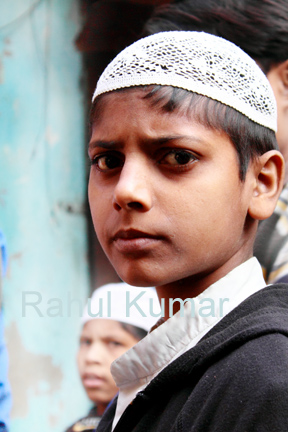
A street shot of a boy looking straight into the camera.
Far from the controversies caused by complex corporate micro finance groups in Andhra Pradesh and farmers suicides in Maharashtra due to non-repayment of loans given by powerful political money-lenders, Delhiites from the sub-prime classes are taking small loans to boost their earning capacities.
Women living in slums and families from the lower socio-economic sections in the Indian capital are taking loans as little as 5,000 at interest rates of around 25 per cent per annum. Even these tiny amounts help them buy a coffee-vending machine; start a business of selling chappals; open a kitchen to supply tiffins to people working in the neighbourhood; make small plastic caps for lipstick covers or manufacture lamp shades from home.
In east Delhi’s resettlement colony of Seelampur, a group of five Muslim women took loans between Rs 5,000 to Rs 15,000 all for various businesses. Shaheen from the east Delhi area of Seelampur has opened up a small embroidery unit where she has been able to employ three other women who work alongside her to help her grow her business. “I pay these women according to the number of hours they work, which can be upto Rs 100 for eight hours,” she says brimming with confidence. There was a time just one year back when she used to work alone but the loans she took from Shikhar Finance enabled her to grow her business.

This group of five women - Shaheen, Mumtaz, Nazma, Ishrat Jahan and Shahan at a meeting to pay back an instalment to a representative of Shikhar Finance company.
So how did she spend her money? “I spent the loan money on cloth and material so that I could make my own cushions and sell them to high-end shops. Instead of just doing embroidery for shops, I started selling them my own stuff.” Her husband, who drives an autorickshaw, did not interfere when she decided to take the loan but did make it clear that she has to take responsibility for clearing the loan amount. Shaheen’s family uses a heater, refrigerator, cooler and her small home has a steel cupboard. Shaheen has actually become the voice of the Delhi-based Shikhar Finance in her neighbourhood.
Inspired by Shaheen’s story, Mumtaz, a distant neighbour, whose son was a chappal salesman and earned a paltry commission that was hopelessly insufficient to meet their meagre ends took courage. She took a loan, bought the footwear herself and set out with her son to sell it at various weekly markets. Now the two of them sell their own product, which is both satisfying and getting them more money, and the thought of repaying the loan with an interest does not scare Mumtaz.

Mahesh Babbar stitches the fabric in his kitchen while the other assembling is done in his bedroom
The harsh truth is that micro loans have not turned around people’s lives dramatically. Most still remain poor and the bigger things in life – marrying a daughter, buying property, adding the barest of comforts – elude them. On the other hand, tiny doses of money have helped them grow their current business and given them hope for a better future. For example, Mahesh and Beena Babbar have been able to expand their lamp shades-making business and now employ a full-time staffer. He has been able to expand his business with the Rs 10,000 loan that he availed.
Less than six months back Babbar, who lives in Trilokpuri, used to get a meagre salary of Rs 4,000 for making lamp shades. Dissatisfied with life, he quit his job and remained unemployed for a while. “A friend’s wife who had taken a loan urged me to start my own business in the same line of work. I took a loan and bought materials to assemble lamp shades. Within a couple of months, I have been able to achieve a turnover of Rs 20,000,” says a satisfied Babbar. He says that he may again take advantage of a similar loan to increase his business. He offers nearly 400-500 lamp shade designs between Rs 85 to Rs 150, which might sell for as much as Rs 1,500 in the plush markets of central Delhi.
The confidence that the lamp shade maker shows is not reflected in Ramji and Seema’s business. The two live in slums in east Delhi and manufacture lipstick caps which are sold to wholesalers. Ramji’s wife took the loan so that her husband could buy another machine – both of which lie on a hard bed in the bedroom of his one-room house. His biggest problem is that he gets to operate his machines only when there is no power cut. With massive power cuts in Ramji’s slum, his work remains badly affected.

Ramji at work in his bedroom factory.
The positive thing in Ramji’s life is that his loans have facilitated him in being able to buy two machines which have increased his manufacturing and selling capacity. But for the father of five school-going children, life continues to remain a struggle as he battles power cuts and saves money for his daughter’s marriage.
The irony is that these impoverished and illiterate families are barely aware of the changes taking place in the legislative sphere that governs micro-finance. For them banks do not exist and most of these people will not be given a loan even by government banks. Alternatively, life in the global economy is such that big businesses access cyclopean loans with bribes and rural money lenders take lives along with interest rates of over 100 per cent in return for the loans they give.
For the poor Indian family, the current financial system is about getting the worst of both - the modern and the traditional economy.
Tuesday, October 26, 2010
Jump Start: Join the Dots

Words of Wisdom. Now you know why publishers never lend and why people don't return.
It was a festival of writers, editors, publishers, illustrators, teachers, librarians and children. The two-day Jump Start: Join the Dots fest organised in Delhi in August by the German Book Office had interesting workshops, interactions and seminars. The discussions included those on illustrations for children's books, graphic novels, e-readers and also contracts between editors and publishers. For me personally, it was an opportunity to meet up with new publishers as well as understand the industry moods and mechanisms.

That is story teller Paro Anand. She mesmerises children and spins tales too. Reading stories to children helps build mental and emotional images for them.
Why is it important to read stories to children? Because, it develops listening skills in children, increases their attention span, stimulates creativity and imagination, improves their vocabulary and they learn problem solving skills. Neel Chaudhuri from The Tadpole Repertory said: "A narrator's voice has to be friend. Repetition is the key to reading stories to children. That was something that Paro Anand, writer and story-teller agreed with: "Children read the same story again and again just because they like that story."

This is how a message board of the non-virtual world is.
Swati Mehta from Gali Gali Sim Sim (Sesme Street) said: "It is equally important for children to tell a story as it builds confidence in them, they learn to express themselves and present ideas in a linked-manner." It also helps them build vocabulary and improves diction.

Adults play games too. Story telling for children at the two-day fest. Watching them on the extreme left is Swati Mehta from Gali Gali Sim Sim (Sesme Street).
There was an interesting observation on the reading habits in children by a member of the audience. She said: "Parents now prefer activity books for their children and have started to avoid story books and fiction." Panelist Nina Sehgal said that even though the variety of books for children has been increasing, the variety for Hindi books remains woefully small. "It is here that a big audience exists which is not being tapped by the publishers." Judith Gueyfier, an illustrator from France who does children's books said that in her country there is a tradition to take stories from Africa and India. "I meet a lot of kids and I learn a lot from them."

This is one of Sekhar Mukherjee's works.

The audience at the session on rights and contracts between authors and publishers. The role of literary agents too was discussed.
A piece of advice for authors while negotiating a price for their books. "Be selective about your rights and limit the terms and terrritories. The rights for printed books, e-books and audio books have to be negotiated separately. The selling of sub-rights to third parties can be in the original language or another language." says Renate Reichstein.

Don't go by the written word!! The name plates on the panelists table are wrong thanks to the angle of the camera.
Writer and publisher, Urvashi Butalia from Zubaan Books tread the path cautiously as she listed out how publishers make money. "They get money from two sources. Through the sale of their books and also by selling the rights of books to other publishers and overseas markets." And how do publishers and their editors actually select books? India's first literary agent, Jayapriya Vasudevan who is now based in Singapore, says: "We look at books that are universally acceptable. Also, we withhold the e-book rights on the request of the authors."

Gautam John, Ameena Batada, Akshaya Pathak, Arti Jain and Binoo John at the discussion on new technologies. And I had thought that new technologies have by now become old.
Technology issues and digital divide too came under the scanner. As Ameena Batada from Gali Gali Sim Sim (Sesme Street) asked: "Should children's story books need batteries?" At the same time, her own organisation is moving into audio books, internet story books and even internet-based read aloud books.
But Gautam John from education NGO Pratham pointed out that digital books are being downloaded and printed. Their books are being read by children who are visually-challenged and technology is helping generate volume and content.
Wink, India's own second-e-book reader was represented by their content person Binoo John, whose company is looking at generating content through tie-ups with Indian publishers and also directly from the authors. "Books on e-readers are 25 per cent lesser than the printed versions. We will also ensure that the books on our e-reader cannot be forwarded," John said.

In the session on graphic novels, it seems nobody asked, and because nobody asked nobody tried explaining how are graphic novels different from comics, if at all they are different? We too will leave it at that. But we had interesting discussions as illustrators and 'graphic-novelists' dwelt on why they were doing what they were doing. Some used their illustrations to ask and explore, the others to repackage Indian mythical stuff into six-pack abs (to gain a universal audience) and some dwelt on the tenuous relations between man, environment and the society.

It is a comic. It is a novel. No, it is a graphic novel.
In the session on graphic novels, it seems nobody asked, and because nobody asked nobody tried explaining how are graphic novels different from comics, if at all they are different? We too will leave it at that. But we had interesting discussions as illustrators and 'graphic-novelists' dwelt on why they were doing what they were doing. Some used their illustrations to ask and explore, the others to repackage Indian mythical stuff into six-pack abs (to gain a universal audience) and some dwelt on the tenuous relations between man, environment and the society.

Actor Danish Husain from the movie Peepli Live
On creating stories that hold the attention of people, actor Danish Husain said: "You make a story with 10 per cent skills and 90 per cent passion." What he probably missed was that passion is the only ingredient that is de rigueur for any measure of success in any sphere.

These children made presentations on their reading habits, favourite books and their hobbies.
The event was as much for children as it was for the publishing industry and writers. Young book worms made a presentation at the Pecha Kucha evening on their W's of reading - what, why and also why they are not reading certain books and authors. What was noteworthy was their confidence and their wide range of reading.

Another story reading, but for the seniors this time. The Tadpole Repertory at work.
It was here, at the close of a two-day session, that I leant two things. Either that I suffer from an attention deficit disorder or that long book readings should be held only for children, povided they do not scoot out to play hop scotch.

This is called an APOLOGY. For those speakers, writers, authors, publishers and children, and of course the organisers, that I may have missed out in my writing or my photos. I am sure I have indeed overlooked many creative and excellent people as the event was not small and had many parallel sessions running alongside. Many times I wish I could clone myself.
Subscribe to:
Posts (Atom)